TEAMGROUP has been launching memory products for quite some time now, and with every new product, it has managed to introduce something new that manages to deliver good performance at a budget price. When it comes to NVMe storage, TEAMGROUP has a record of delivering fast solutions for various applications, and it is still going strong. The new TEAMGROUP T-Force G70 Graphene PCIe Gen4 brings back the patented Graphene thermal pad that ensures cooler temperatures so that performance is never dropped, even in stressful conditions. Managing temperature is a difficult task for NVMe drives because only high-end motherboards come with cooling pads by default; however, with options like the TEAMGROUP T-Force G70 PRO, you can get cooling right out of the box. This is our review of the TEAMGROUP T-Force G70 PRO Graphene PCIe Gen4, which is targeted at gaming users for ultra-fast loading speeds.
Technical Specifications at a Glance:
| Specification | TEAMGROUP T-FORCE G70 |
| Form Factor | M.2 2280 |
| Interface | PCIe 4.0 x4 |
| Protocol | NVMe |
| NAND Flash | 3D TLC |
| Controller | InnoGrit IG5236 |
| Capacity | 512GB / 1TB / 2TB / 4TB |
| Sequential Read | Up to 7,000 MB/s |
| Sequential Write | Up to 6,000 MB/s |
| Random Read | Up to 650K IOPS |
| Random Write | Up to 700K IOPS |
| DRAM | No |
| Cache | SLC Cache |
| Endurance (1TB) | 500 TBW |
| Operating Temperature | 0°C–70°C |
| Dimensions | 80 × 22 × 3.7 mm |
| Weight | 7g |
| Warranty | 5 Years Limited |
| Price (At the time of publishing) | $197 (1 TB Graphene variant) |
What’s in the Box?
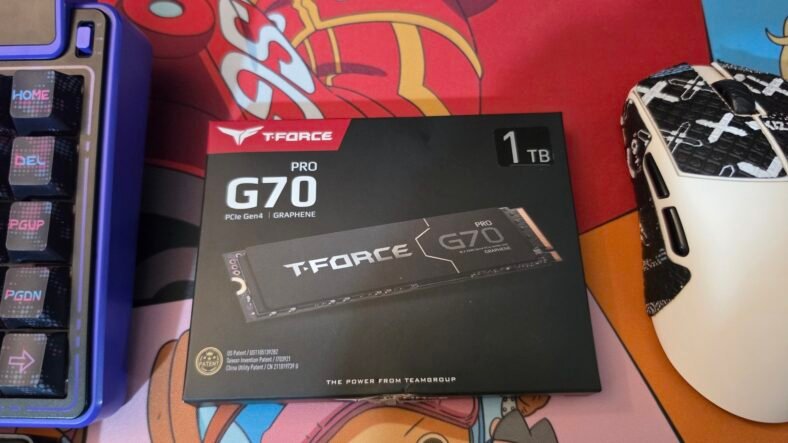
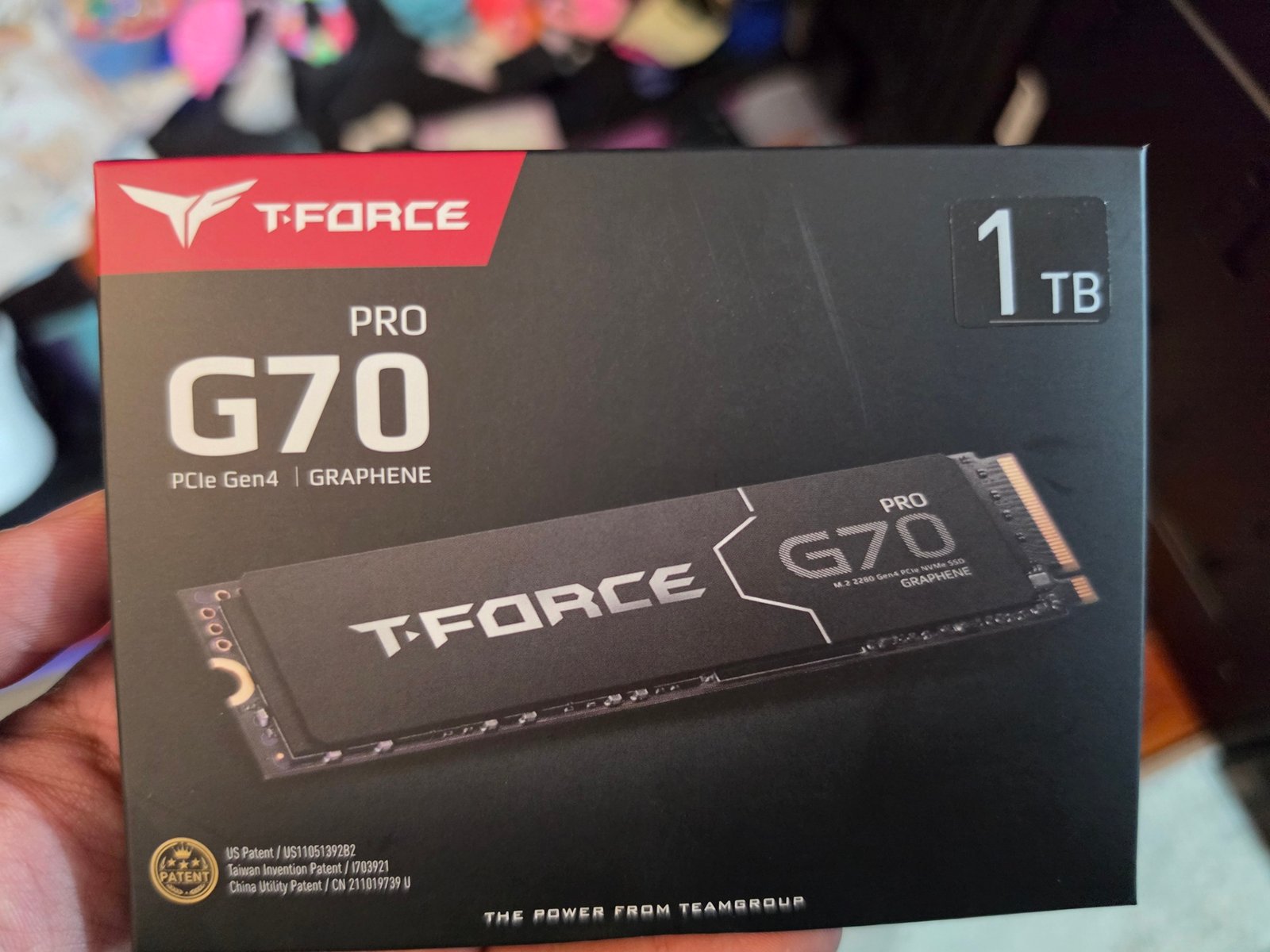
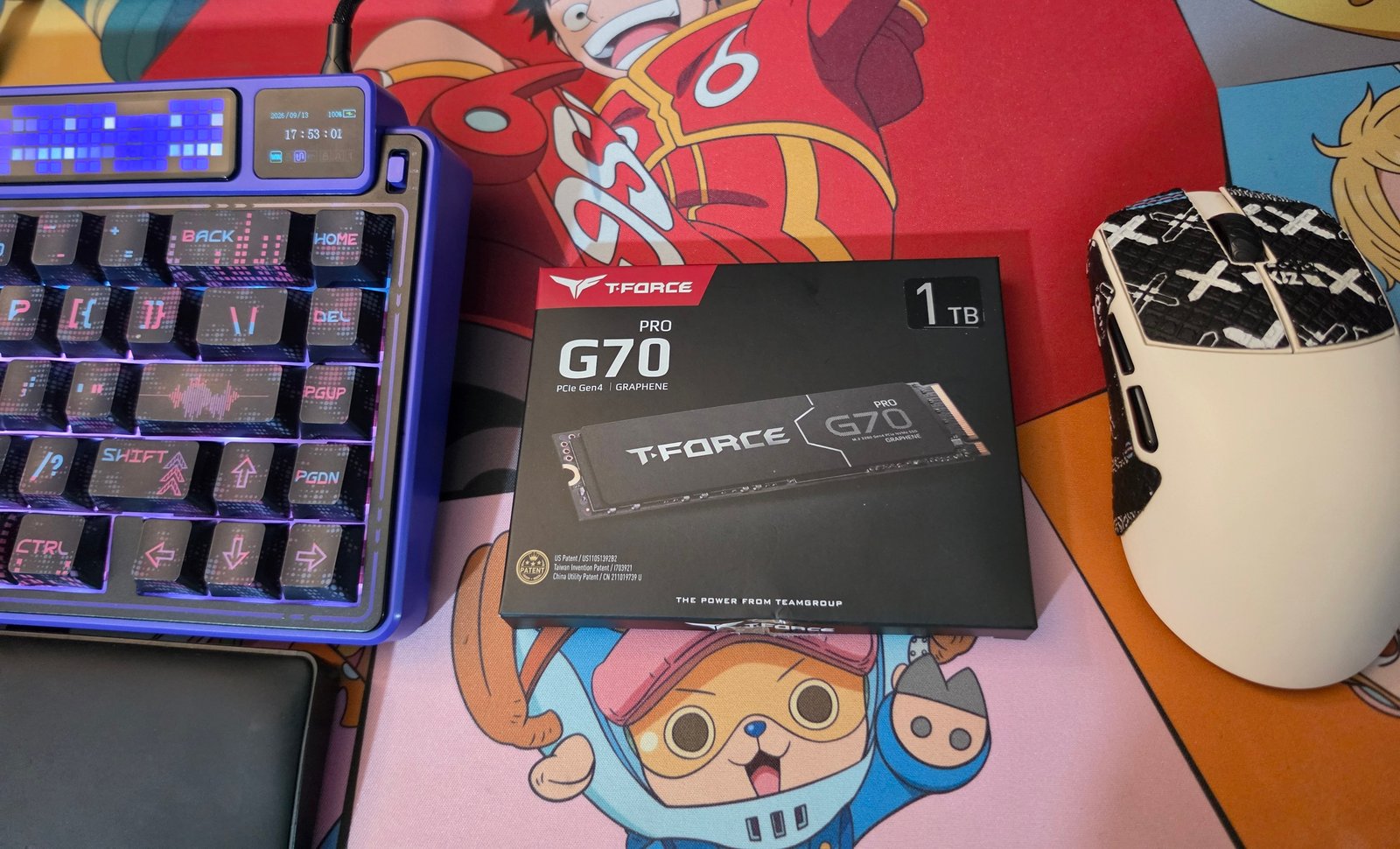
Our TEAMGROUP T-Force G70 PRO arrived in a basic black box that showcased the NVMe at the front along with its branding and clearly marking the variant. Since TEAMGROUP sent us a 1 TB variant with the Graphene cooling pad, the box represented that. On the back, it has warranty information in multiple languages, key specifications in a small table, an installation guide printed right on the box, and a small window showcasing the NVMe inside.
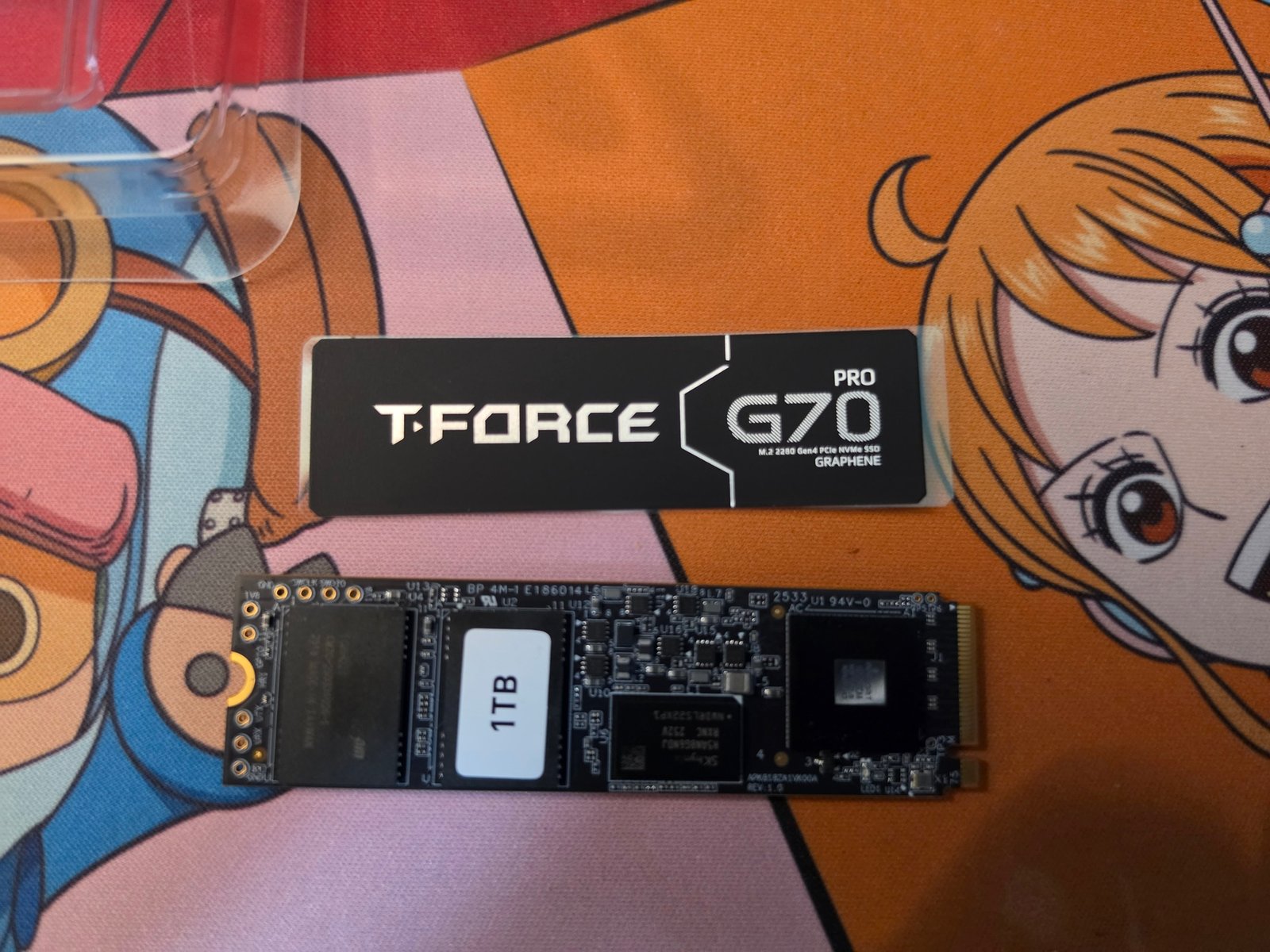
Out of the box, the TEAMGROUP T-FORCE G70 M.2 PCIe 4.0 SSD is an NVMe drive using a PCIe Gen4 x4 interface, available in capacities from 512GB to 4TB. The 1TB model tested here is rated for sequential read speeds of up to 7,000 MB/s and sequential write speeds of up to 6,000 MB/s, with a 500TBW endurance rating. It uses SLC caching rather than DRAM, comes with a thin graphene heatsink, measures 80 × 22 × 3.7mm, weighs just 7g, and has an operating temperature range of 0°C–70°C. TEAMGROUP backs the drive with a five-year limited warranty.
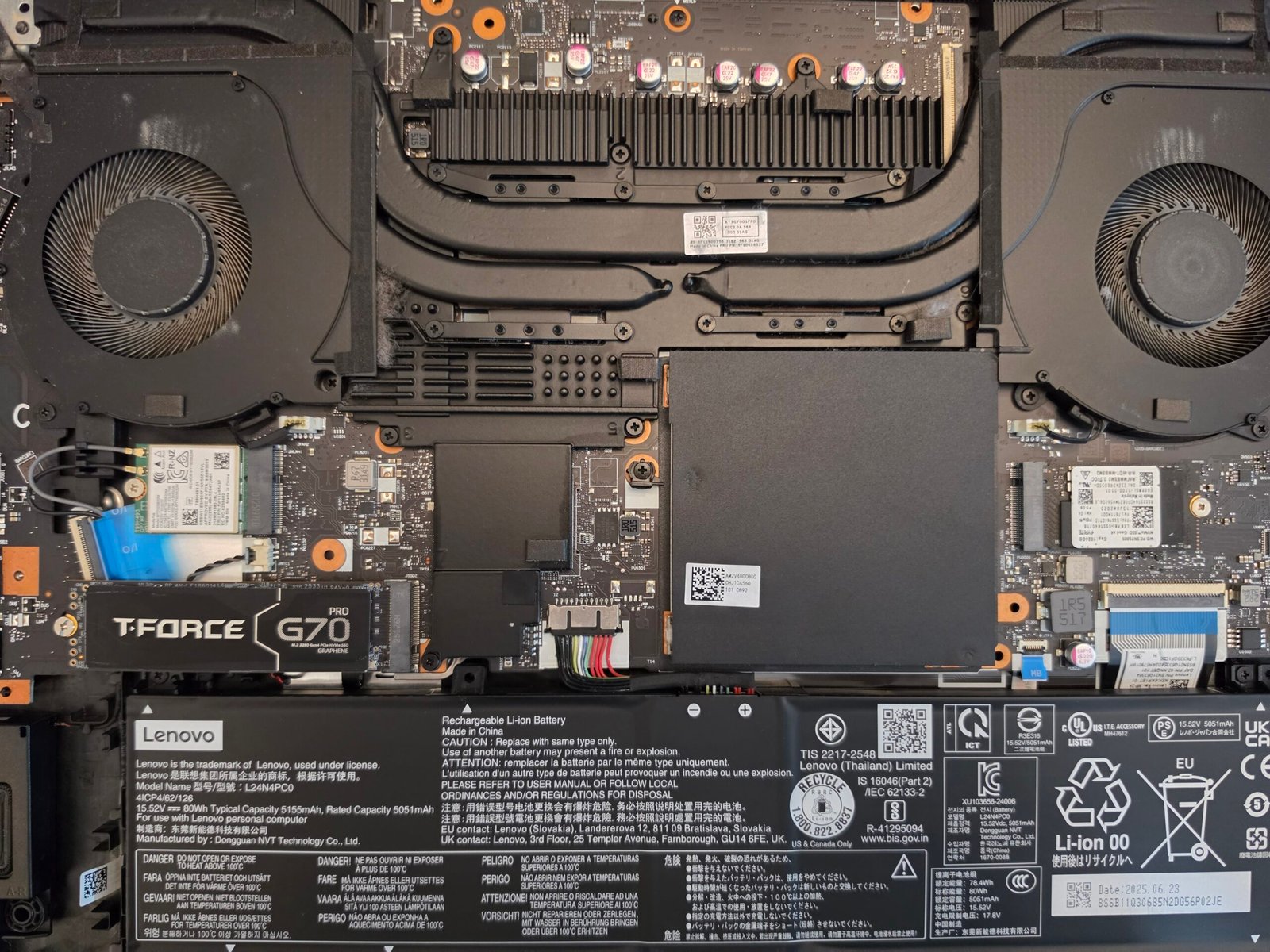
SLC caching allows the SSD to temporarily use a portion of its TLC NAND as faster SLC storage, boosting write performance. However, sustained write speeds can decrease once the available cache is exhausted. Due to the thin profile of the G70 PRO Graphene, it can also be easily used with laptops.
Test Bench:
For testing the performance of the TEAMGROUP T-Force G70 PRO, we used Windows 11, and the system had three other NVMe drives installed as well. These included Samsung 990 PRO 4 TB, WD Black SN770 2 TB, and a SAMSUNG 9100 PRO 2 TB, which is a PCIe 5.0 NVMe, but we will only use it as a reference point. The main competition going against the T-Force G70 PRO Graphene is the SN770 and 990 Pro.
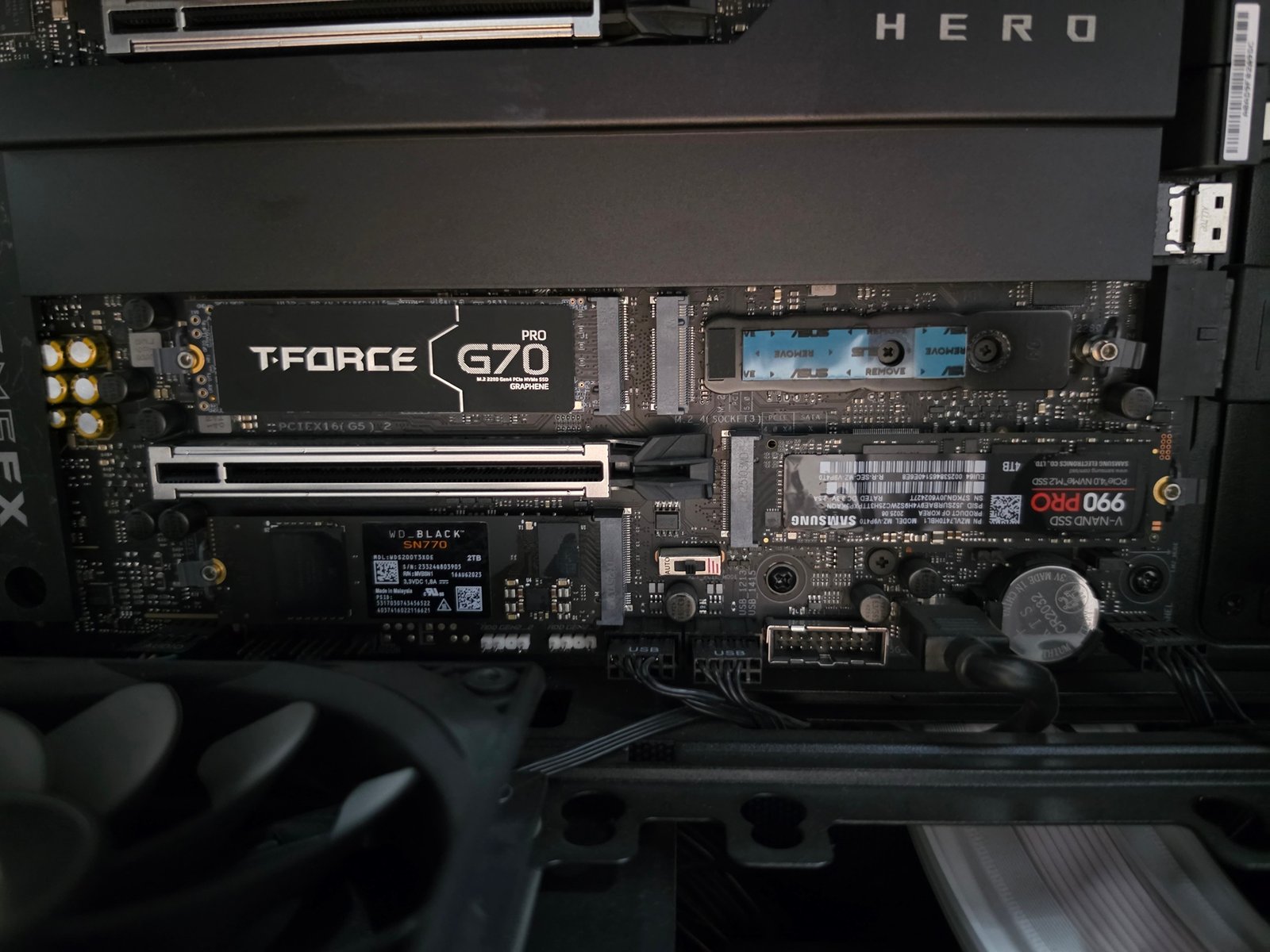
Our test bench system specifications include:
- Processor: AMD Ryzen 9 9950x3D
- Motherboard: ASUS ROG Crosshair X870E
- GPU: ASUS Astral RTX 5090 OC
- Memory: CORSAIR VENGEANCE RGB 96 GB DDR5 6000 MHz CL30
- PSU: Corsair RM1000x
- Windows 11 64-bit (Latest Update)
- OS Storage: SAMSUNG 9100 Pro 2 TB
Benchmarks:
For benchmarks, we have compared it directly against the 990 Pro and the SN700 with software like ATTO Disk, CrystalDiskMark, and live file-transfer scenarios.
ATTO Disk Benchmark:
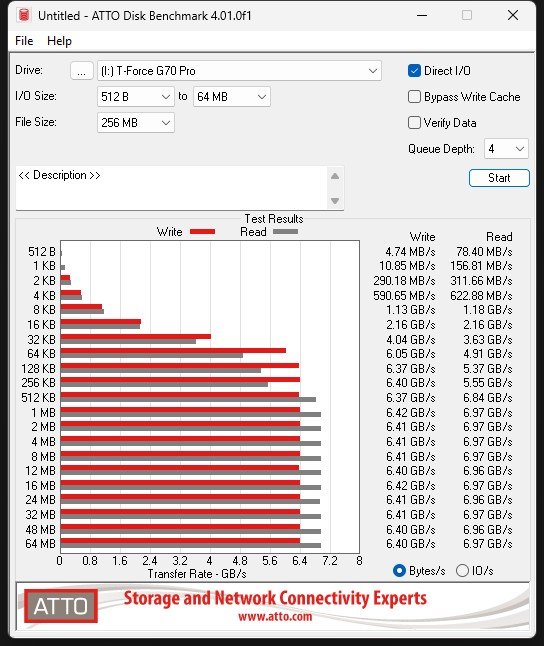
The TEAMGROUP T-Force G70 Pro shows a strong performance curve in ATTO Disk Benchmark, with throughput scaling rapidly as the transfer size increases. At the smallest 512 B transfer size, the SSD manages 4.74 MB/s write and 78.40 MB/s read, but performance quickly improves as larger transfers are introduced.
By 16 KB, both write and read speeds have surpassed 2 GB/s, while 64 KB pushes write performance to 6.05 GB/s and read performance to 4.91 GB/s. The drive continues to scale from there, reaching 6.37 GB/s write and 5.37 GB/s read at 128 KB.
The G70 Pro reaches its strongest read performance at larger transfer sizes, hitting approximately 6.97 GB/s, while write performance settles around 6.40–6.42 GB/s. More importantly, these figures remain remarkably consistent from the 1 MB range through the largest 64 MB transfer tested. This gives the SSD a very stable large-file performance profile, with little fluctuation once it reaches its performance ceiling.
For workloads involving large game installations, file transfers, or other sequential operations, the results indicate that the drive is capable of maintaining high throughput rather than simply producing a strong peak figure.
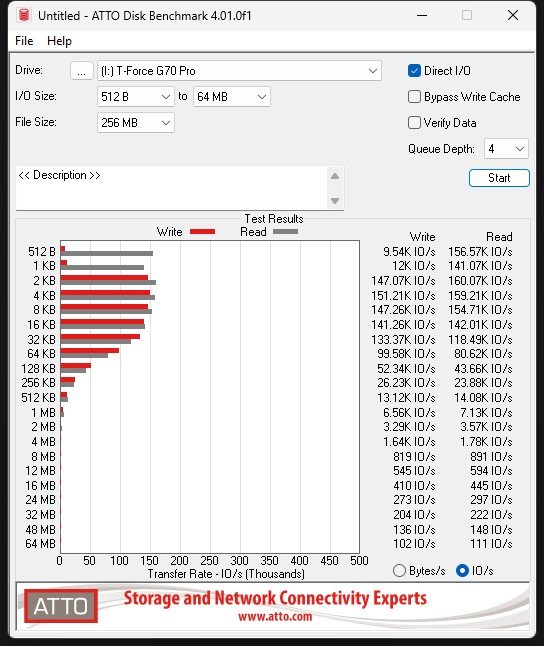
The IOPS results tell a slightly different story, as the highest figures occur with smaller transfers. The G70 Pro reaches approximately 151K write IOPS and 160K read IOPS around the 2–4 KB range in this QD4 test. As transfer sizes increase, IOPS naturally falls because each individual operation is handling more data; at 1 MB, for example, the drive records around 6.56K write and 7.13K read IOPS, while still delivering 6.42 GB/s write and 6.97 GB/s read.
At 64 MB, IOPS drops further to 102K? No,102 write and 111 read IOPS, but throughput remains at 6.40 GB/s and 6.97 GB/s. This illustrates that the declining IOPS at larger transfer sizes isn’t indicative of the SSD slowing down; instead, it reflects the larger amount of data being transferred per individual I/O operation.
CrystalDiskMark Benchmarks:
For testing the T-FORCE G70 PRO 2TB, the G70 PRO was installed in a PCIe 4.0 M.2 slot and tested using CrystalDiskMark 9.0.3 with the default 1GiB test size and five runs.
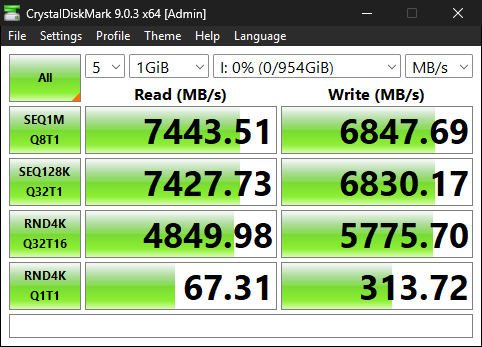
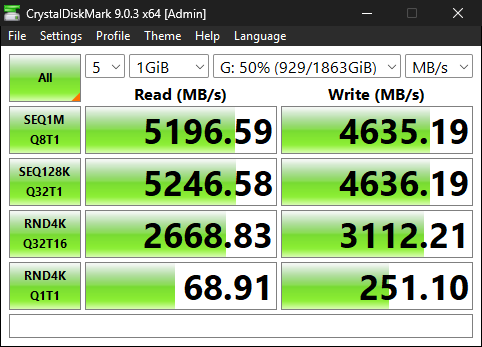
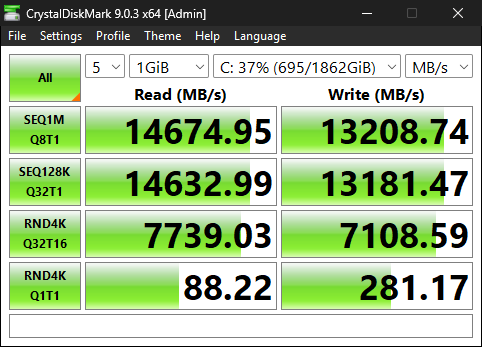
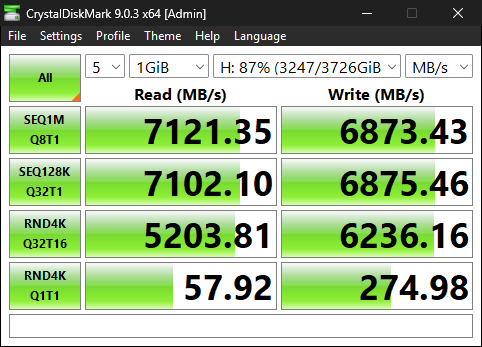
To put the results into context, we also tested Samsung 990 PRO 4TB, WD_BLACK SN770 2TB, and Samsung 9100 PRO 2TB on the same system. The first three drives operated over PCIe 4.0, while the 9100 PRO was installed in a PCIe 5.0 slot and is therefore included primarily as a next-generation performance reference.
TEAMGROUP rates the 2TB G70 PRO for sequential speeds of up to 7,400 MB/s read and 6,800 MB/s write. The drive also features DRAM caching and carries a rated endurance of 1,480 TBW.
| SSD | Interface | Seq. Read | Seq. Write | 4K Q32T16 Read | 4K Q32T16 Write | 4K Q1T1 Read | 4K Q1T1 Write |
| T-FORCE G70 PRO 2TB | PCIe 4.0 | 7,443.5 | 6,847.7 | 4,850.0 | 5,775.7 | 67.31 | 313.72 |
| Samsung 990 PRO 4TB | PCIe 4.0 | 7,121.4 | 6,873.4 | 5,203.8 | 6,236.2 | 57.92 | 274.98 |
| WD_BLACK SN770 2TB | PCIe 4.0 | 5,196.6 | 4,635.2 | 2,668.8 | 3,112.2 | 68.91 | 251.10 |
| Samsung 9100 PRO 2TB | PCIe 5.0 | 14,675.0 | 13,208.7 | 7,739.0 | 7,108.6 | 88.22 | 281.17 |
All values are MB/s. Results are from our CrystalDiskMark testing.
Sequential Performance
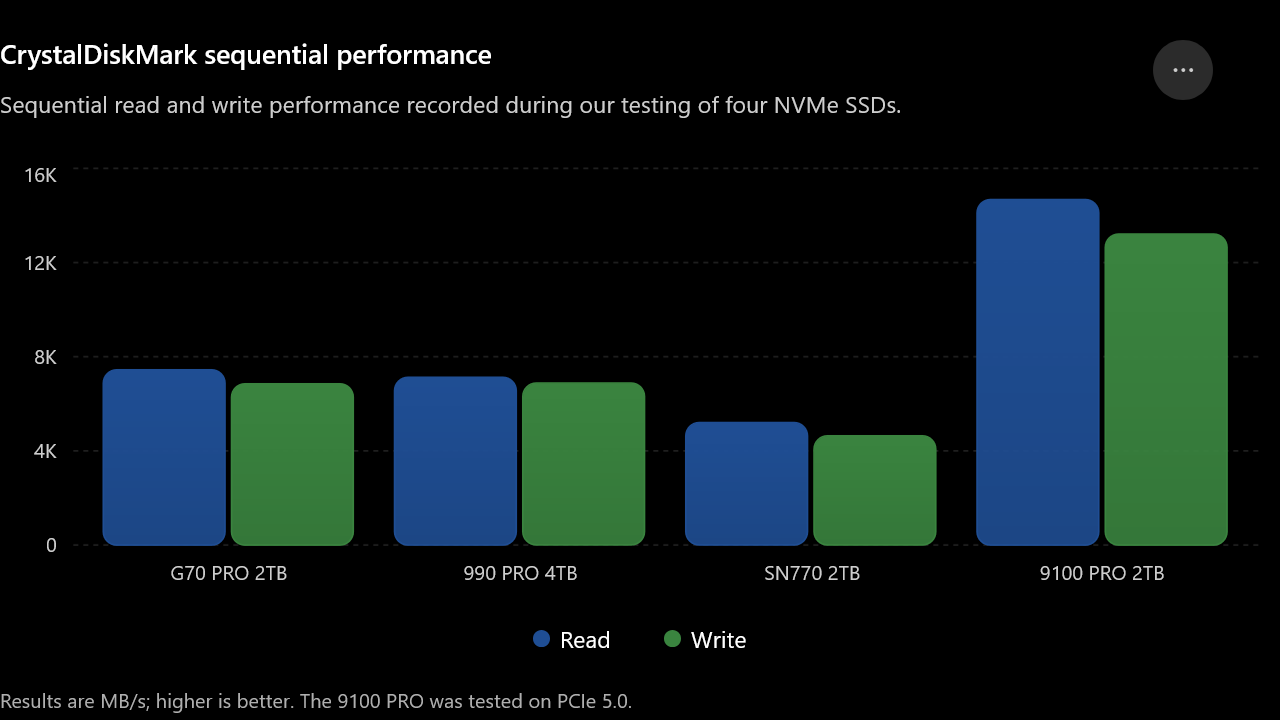
The G70 PRO delivered 7,443.5 MB/s sequential read and 6,847.7 MB/s sequential write.
Those numbers are particularly noteworthy because they essentially match, and marginally exceed, the manufacturer’s rated sequential performance of 7,400/6,800 MB/s.
Compared with the Samsung 990 PRO, the G70 PRO was:
- 5% faster in sequential read
- 4% slower in sequential write
The two drives are therefore extremely close in sequential throughput.
Samsung rates the 4TB 990 PRO at up to 7,450 MB/s read and 6,900 MB/s write, making the numbers recorded in our testing broadly consistent with both manufacturers’ specifications.
The difference becomes considerably larger when compared with the older WD_BLACK SN770. The G70 PRO was approximately:
- 43% faster in sequential read
- 48% faster in sequential write
The SN770 2TB is officially rated at up to 5,150 MB/s read and 4,850 MB/s write, which is also close to the performance recorded in our testing.
CrystalDiskMark Sequential Performance in a Nutshell
Sequential read and write performance recorded during our testing of four NVMe SSDs
Random Performance
The random tests provide a more nuanced picture.
At Q32T16, the Samsung 990 PRO recorded higher numbers than the G70 PRO:
- 990 PRO read: 5,203.8 MB/s
- G70 PRO read: 4,850.0 MB/s
and:
- 990 PRO write: 6,236.2 MB/s
- G70 PRO write: 5,775.7 MB/s
That represents an advantage of approximately 7.3% in read and 8.0% in write for the 990 PRO in this particular test.
However, the G70 PRO turned the tables in the low-queue-depth Q1T1 test. Its 67.31 MB/s random read and 313.72 MB/s random write results were higher than the 990 PRO’s 57.92 MB/s and 274.98 MB/s, respectively.
The G70 PRO’s Q1T1 random write result was approximately 14% higher than the 990 PRO’s result.
This distinction is worth mentioning because Q1T1 workloads are closer to the type of low-queue-depth storage activity associated with many everyday desktop operations than the highly parallel Q32T16 workload.
That doesn’t mean these differences will translate directly into a 14% faster Windows experience—the relationship between synthetic random-storage benchmarks and real-world application performance is much more complicated—but it does demonstrate that the G70 PRO isn’t simply relying on sequential throughput to produce its benchmark numbers.
Drive Capacity
The drives were tested at different levels of utilization:
| SSD | Capacity Used During Test |
| G70 PRO 2TB | 0% |
| SN770 2TB | 50% |
| 9100 PRO 2TB | 37% |
| 990 PRO 4TB | 87% |
The G70 PRO was essentially empty during testing, whereas the 990 PRO was already 87% full. SSD performance can vary depending on workload, available spare area, background garbage collection, and other factors, so this should be considered when interpreting the direct comparison.
Consequently, we would not characterize this benchmark as proving that the G70 PRO is inherently faster than the 990 PRO.
What the results do demonstrate is that the G70 PRO can deliver 990 PRO-class sequential performance in this test, while also producing stronger Q1T1 results in our particular run.
Samsung itself notes that SSD performance can vary according to firmware, system hardware, configuration, and other factors.
PCIe 5.0 Reference: Samsung 9100 PRO
The 9100 PRO achieved:
- 14,674.95 MB/s read
- 13,208.74 MB/s write
Those results are roughly 97% faster in sequential read and 93% faster in sequential write than the G70 PRO.
However, this isn’t an apples-to-apples comparison.
The 9100 PRO was operating on PCIe 5.0, whereas the G70 PRO is a PCIe 4.0 x4 SSD. TEAMGROUP specifies the G70 PRO as a PCIe 4.0 x4 drive with up to 7,400/6,800 MB/s sequential performance.
The 9100 PRO is therefore best viewed in this review as a demonstration of the performance ceiling available from the newer PCIe 5.0 interface rather than as a direct competitor to the G70 PRO.
G70 PRO vs. the Competition
From the numbers we recorded, the G70 PRO occupies an interesting position.
Against the SN770, it provides a substantial increase in sequential and high-queue random throughput.
Against the 990 PRO, however, the situation is much closer.
The G70 PRO essentially matches the Samsung drive in sequential performance, while the 990 PRO maintains an advantage in our Q32T16 testing. At Q1T1, meanwhile, the G70 PRO recorded stronger read and write numbers.
That makes the G70 PRO’s benchmark performance particularly competitive for a PCIe 4.0 SSD.
Real-World File Transfer:
Synthetic benchmarks provide a useful indication of an SSD’s maximum throughput, but real-world file transfers can paint a different picture. To complement our CrystalDiskMark testing, we also performed a large-file transfer to the T-FORCE G70 PRO.
During the transfer, Windows reported a transfer rate of approximately 3.68 GB/s, with the operation already 56% complete. The test involved copying a large video file of approximately 33 GB to the G70 PRO.
The observed transfer rate is substantially lower than the drive’s 6,800 MB/s rated sequential-write performance and our 6,847.7 MB/s CrystalDiskMark result. This difference is expected because a Windows file-copy operation is influenced by factors beyond the SSD’s peak sequential throughput, including the source storage device, filesystem, Windows caching, and the characteristics of the data being transferred.
Nevertheless, maintaining approximately 3.68 GB/s during a real-world file transfer demonstrates that the G70 PRO is capable of very high throughput outside of synthetic benchmarking environments.
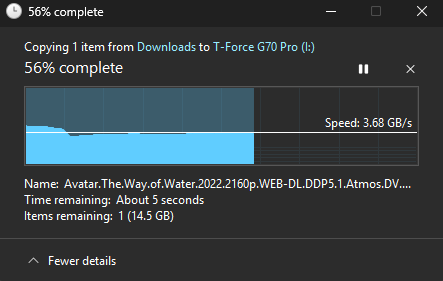
Note: The displayed Windows transfer speed represents the transfer rate at the moment the screenshot was captured rather than a complete-test average, so it should not be interpreted as the G70 PRO’s definitive sustained-write speed.
Thermal Performance:
Thermals are an important consideration for modern NVMe SSDs, particularly high-performance models that can generate significant heat during sustained workloads. To evaluate the G70 PRO, we monitored its SMART temperature sensors alongside the three comparison drives during our testing.
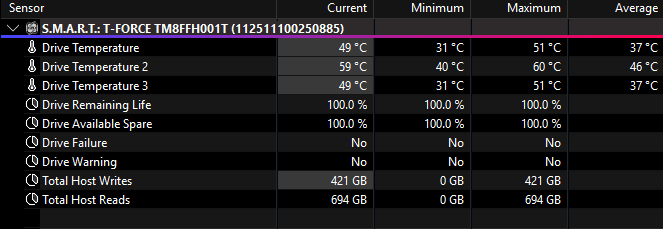
The results were encouraging. The T-FORCE G70 PRO recorded a maximum temperature of 51°C on its primary sensor and 60°C on its secondary sensor, with average readings of 37°C and 46°C, respectively.
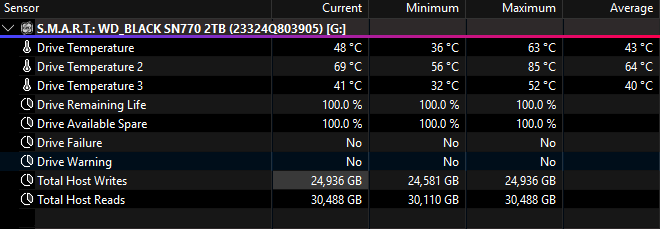
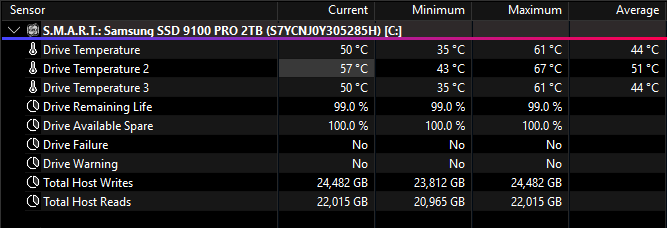
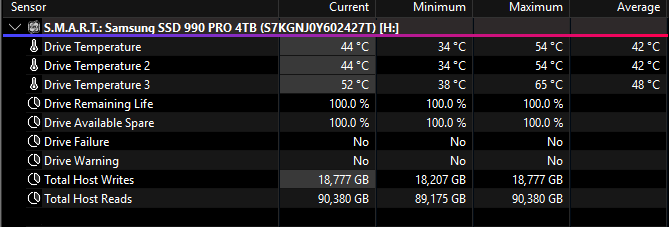
For comparison, the Samsung 990 PRO reached 54°C on its primary sensor and 65°C on its secondary sensor, while the PCIe 5.0 Samsung 9100 PRO reached 61°C and 67°C. The WD_BLACK SN770 recorded the highest readings in our testing, reaching 63°C on its primary sensor and 85°C on its secondary sensor.
Maximum SSD Temperatures:
Maximum SMART temperature readings recorded during our testing period.
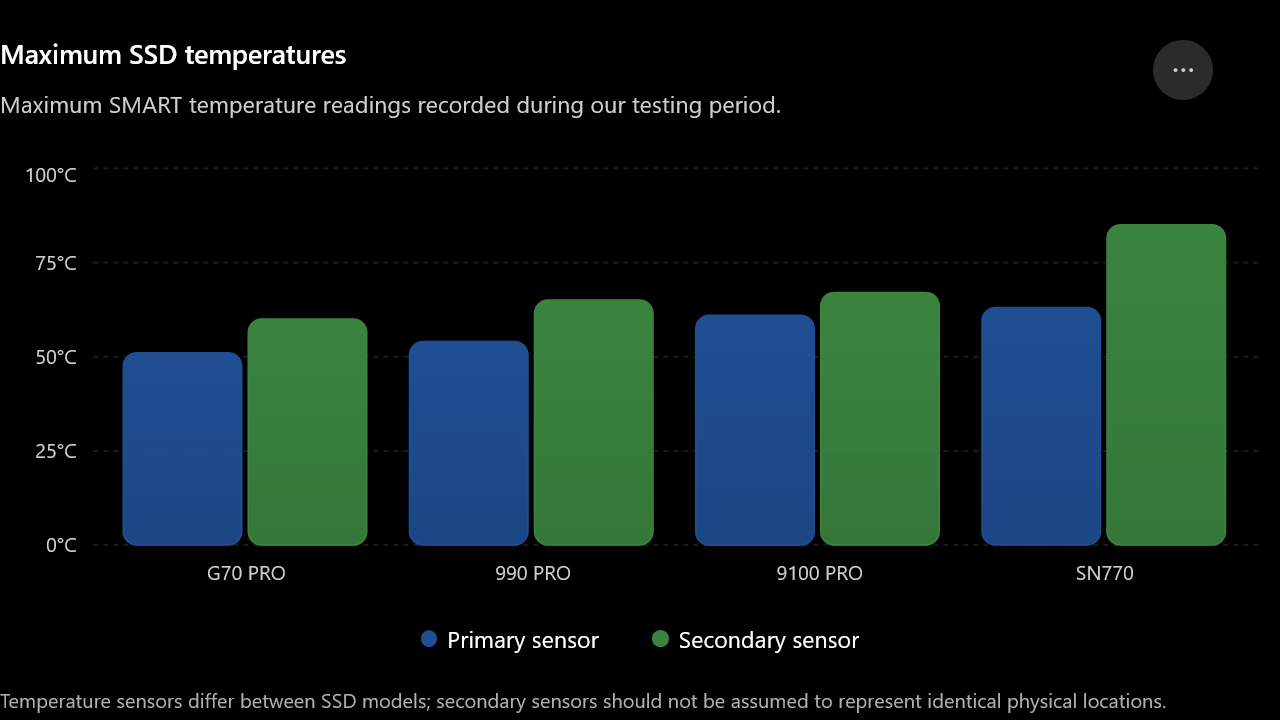
What makes the G70 PRO’s thermal results particularly interesting is that the drive also demonstrated strong real-world transfer performance. During our large-file Windows transfer test, the G70 PRO reached a reported transfer speed of approximately 3.68 GB/s, while its maximum recorded temperatures remained at 51°C and 60°C on its two reported sensors.
In our testing environment, we therefore saw no indication of significant thermal performance degradation during the workloads we ran. The relatively low temperatures should also give users reasonable thermal headroom for sustained workloads, although actual temperatures will vary depending on motherboard heatsinks, airflow, ambient temperature, and system configuration.
Performance Verdict – TEAMGROUP T-FORCE G70 PRO 2TB
The T-FORCE G70 PRO 2TB delivered impressive results throughout our testing. Its CrystalDiskMark sequential performance reached 7,443 MB/s read and 6,848 MB/s write, essentially matching its advertised 7,400/6,800 MB/s figures.
The G70 PRO also performed competitively against the Samsung 990 PRO. While the Samsung produced higher Q32T16 random results in our testing, the G70 PRO delivered higher Q1T1 read and write results and essentially matched the 990 PRO in sequential throughput. Against the WD_BLACK SN770, the G70 PRO demonstrated a substantial advantage in both sequential and high-queue-depth performance.
Our real-world file-transfer test provided another useful data point. The G70 PRO reached approximately 3.68 GB/s while copying a large video file under Windows, demonstrating that its high throughput isn’t limited exclusively to synthetic benchmarks.
Thermals were another strong point. The G70 PRO recorded the lowest maximum temperatures of the four drives tested, reaching 51°C on its primary sensor and 60°C on its secondary sensor. The drive maintained these relatively modest temperatures despite the high-performance workloads used during testing.
There are some limitations to our comparison. Most notably, the G70 PRO was essentially empty during testing, while the Samsung 990 PRO was at approximately 87% capacity. The 9100 PRO was also running on PCIe 5.0 and therefore isn’t a direct performance competitor to the PCIe 4.0 G70 PRO.
Related Reviews:
- Review: TEAMGROUP ULTRA MicroSDXC A2 V30 Memory Card
- Interview: TEAMGROUP – Blazing-Fast Speeds, Innovative Storage Solutions
- TEAMGROUP Brings AI Hardware, PCIe 6.0 Storage, and Data Destruction Tech to COMPUTEX 2026
Taken together, our results show the TEAMGROUP T-FORCE G70 PRO to be a high-performance PCIe 4.0 NVMe SSD with excellent sequential throughput, strong random performance, high real-world transfer speeds, and comparatively low temperatures in our test environment. For users looking for a fast PCIe 4.0 drive for gaming, large-file workloads, and general high-performance desktop use, the G70 PRO delivers a compelling performance profile.