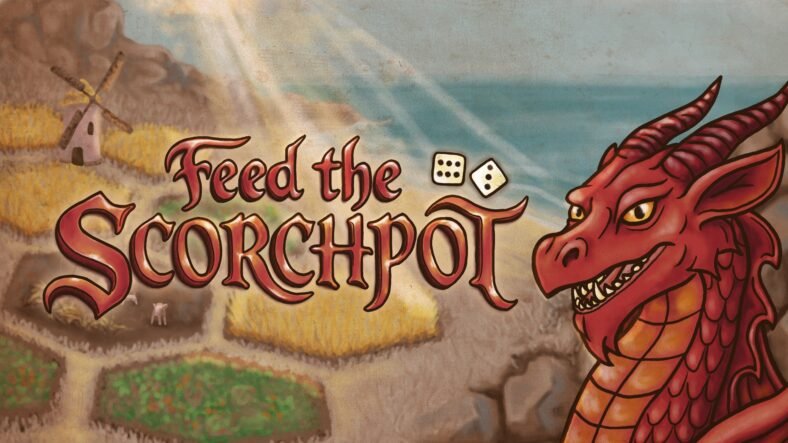
Developed by two-person indie developer Moravian and published by WhisperGames, and Indieformer, Feed the Scorchpot is a roguelike game where you must prepare meals and feed a dragon in hopes of it allowing you and your little island settlement to thrive. Feed the Scorchpot is not your typical city management game because your goal here is not to micro-manage your settlement, but rather you have to build the settlement so that it is capable of creating enough food for the dragon that is towering over the island. This is our review of Feed the Scorchpot on PC via Steam, in which we feed a dragon huge meals and try to survive for as long as possible while fulfilling its never-ending hunger.
In Feed the Scorchpot, your goal is to survive while managing a hex-based island where you will collect raw ingredients, cook them up while mixing different recipes, and feed them to a dragon. You get a limited time to meet the hunger milestone, and if you fail, the dragon fries you. The game combines multiple gameplay mechanics, such as rolling dice, deckbuilding, and roguelike progression, into a single experience. At the start of every run, you can choose your dragon, game type, and a custom deck if you have unlocked it. You enter a 20-year contract with the dragon, where you have to meet its hunger milestones before the year ends. Each year offers a limited number of seasons, and you have to meet the target before all seasons have passed.
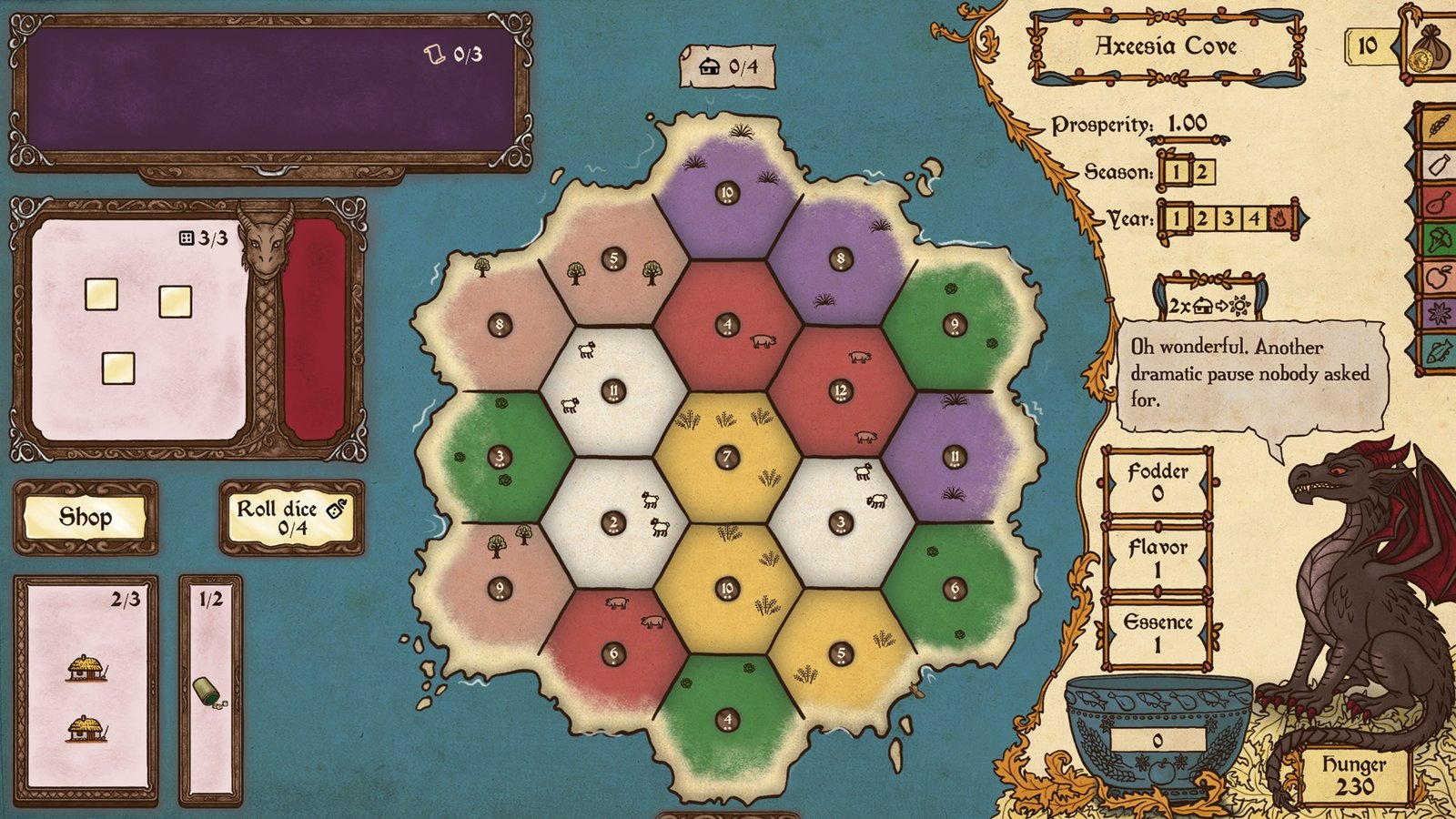
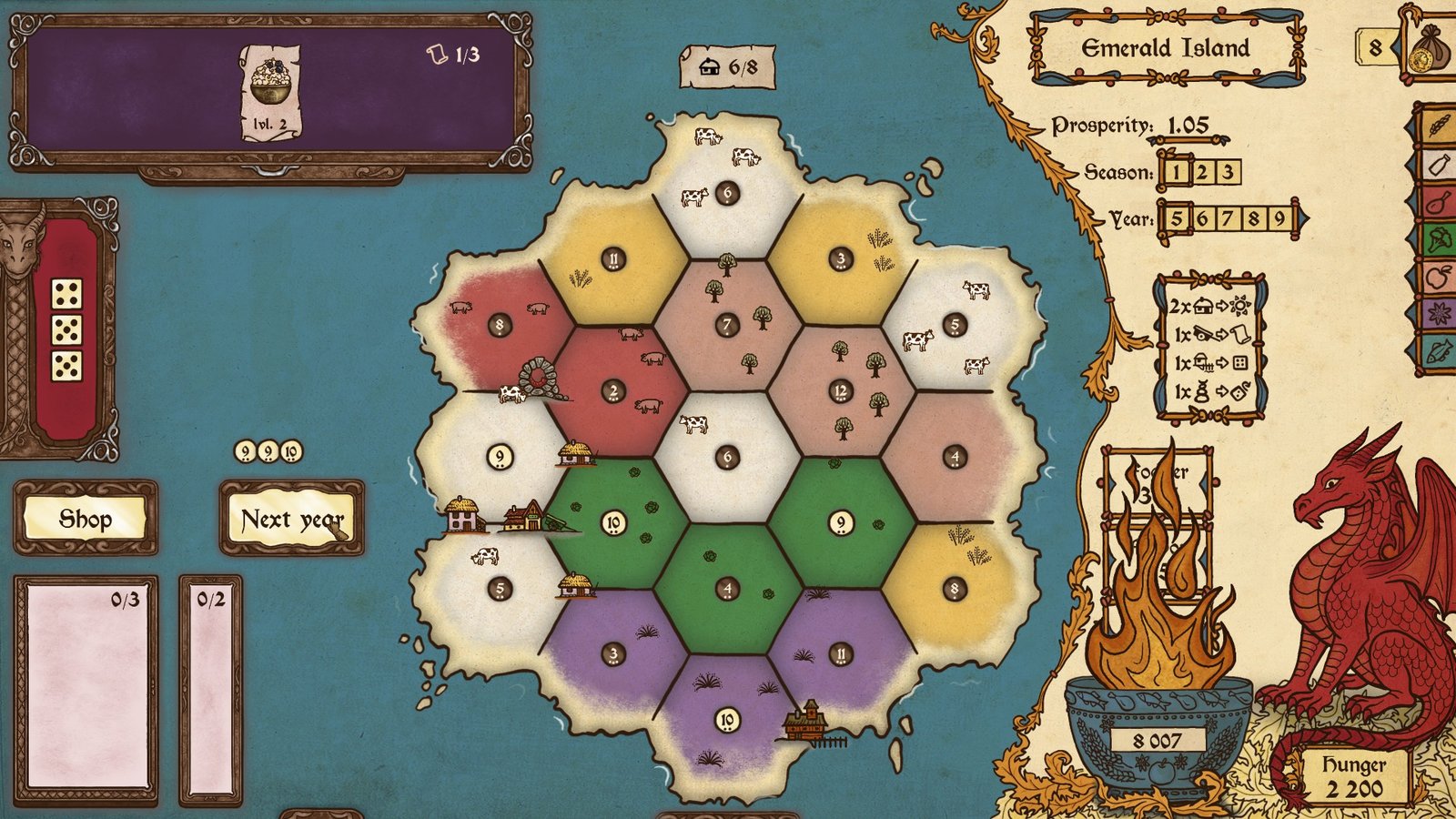
I love the gameplay of Feed the Scorchpot because, while it looks complex, it is fairly simple to understand, and even casual players can easily understand the gameplay mechanics in their first game. In the middle of the screen, you have your hex-like island settlement, which is randomly generated every time you start a game. The game feels exactly like a tabletop game, with the island looking like it is sitting on a table, but it isn’t actually a tabletop game; it simply feels like one. It only feels like it is one. To kick off your run, you must buy and place different buildings on the corners of the hexagons. Placing them on the corners allows you to extract ingredients from the attached hexes based on their types.
Each hex has a different item on it that represents what sort of resource you will get from it. These could be fruits, meat, fish, dairy, grain, and more. Each hex also has a number on it. Putting buildings such as farms and houses will allow peasants to live in them and collect ingredients from the hexes. The buildings can only be placed on the edges of a hex, so placement can be vital. If you place a building optimally, you can use it to extract from three different hexes in the same move. Now, the next part is to roll the dice. With each roll, you can save one number of your choice. Save enough dice, and you will form marks. Marks are created by adding the results of two dice. These marks will activate the hexes where the number is present. For example, if a hex’s number is 10, you must have two dice whose sum is 10. This will allow you to collect the ingredients from the activated hex.
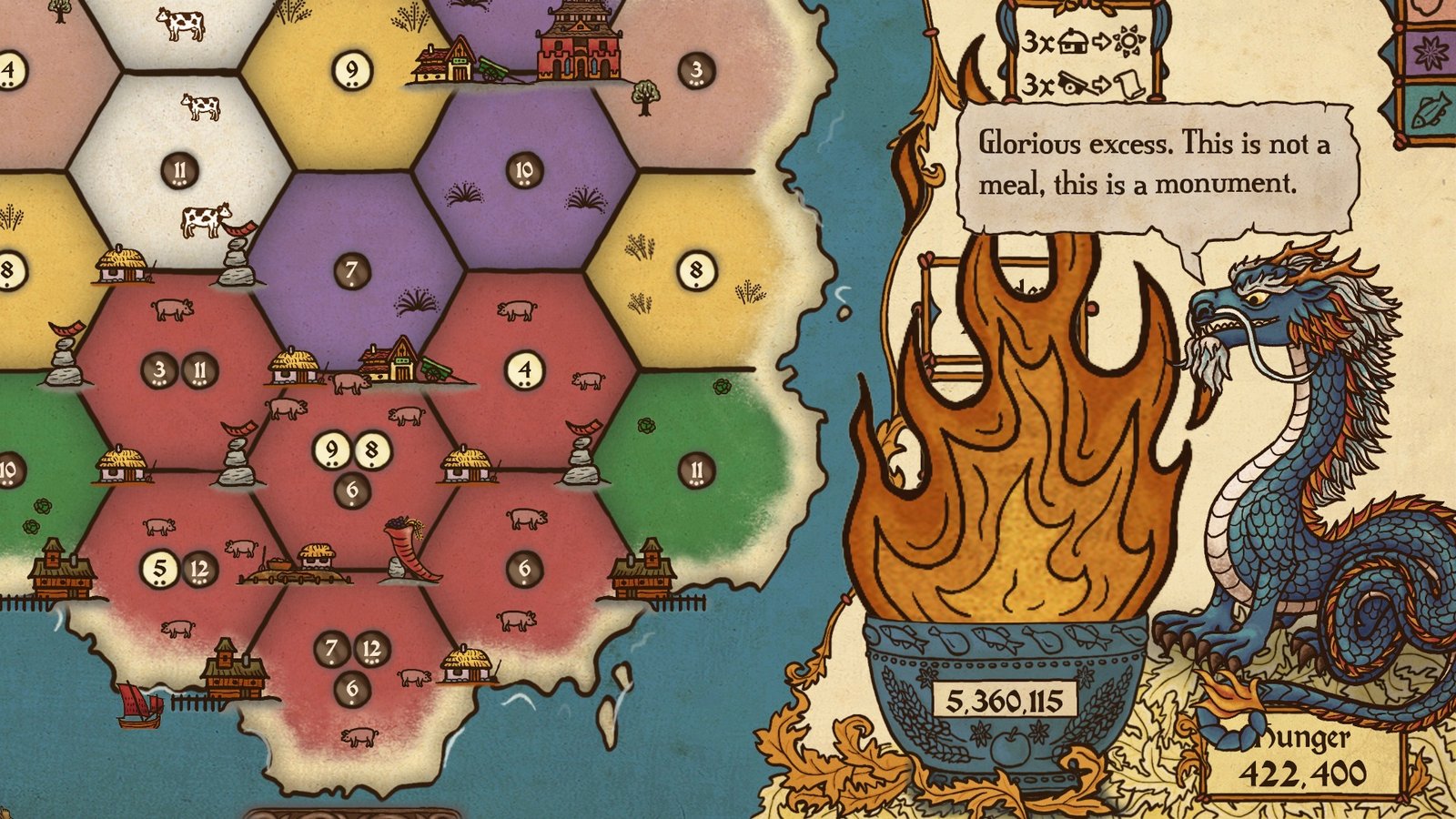
If there are multiple hexes with the number 10, they will all be activated with the same mark. You can create up to three marks in a single turn. Once you use all of your available rolls, or create three marks, you will need to cook and feed the dragon. Feeding the dragon raw ingredients will never be enough to satisfy it. For this purpose, you will need recipes that add flavor along with essence. Flavor is earned through recipes and trade buildings, while essence is earned through high-tier buildings and advanced recipes. At the end of every year, you will gain ducats based on the structures you build on your island, along with any passive bonus from the buildings.
At the start of the game, the island is pretty limited, and you have limited slots for nearly everything. You have fewer dice rolls, fewer dice to roll, fewer seasons every year, and fewer building slots to place on your island. As you progress in the game, you will unlock additional slots and items to help you reach the continuously increasing hunger milestones for the dragon. Every year, the dragon will increase its hunger limit, so you will need a higher amount of food to feed the dragon. Once you add ingredients to the Scorchpot, cooking will multiply the flavor, prosperity, and essence together with the amount of fodder and will also take into account the bonuses from buildings, recipes, and any other special multipliers in place to create insane amounts of food for the dragon.
Each year only has a limited number of seasons before the game moves into the next year, and failure to reach the target hunger will end your run. Different tasks in the game will add some bonuses for you, making it easier, but the game does not technically get easier with upgrades. This is because the dragon’s demand continues to increase as well. It’s like a toddler that continuously throws tantrums, and even after feeding it tons of food, it still badmouths you. If you want to increase a specific mechanic, you can meet its requirements. For example, placing additional buildings will unlock their high-tier versions, which result in better bonuses and ingredients.
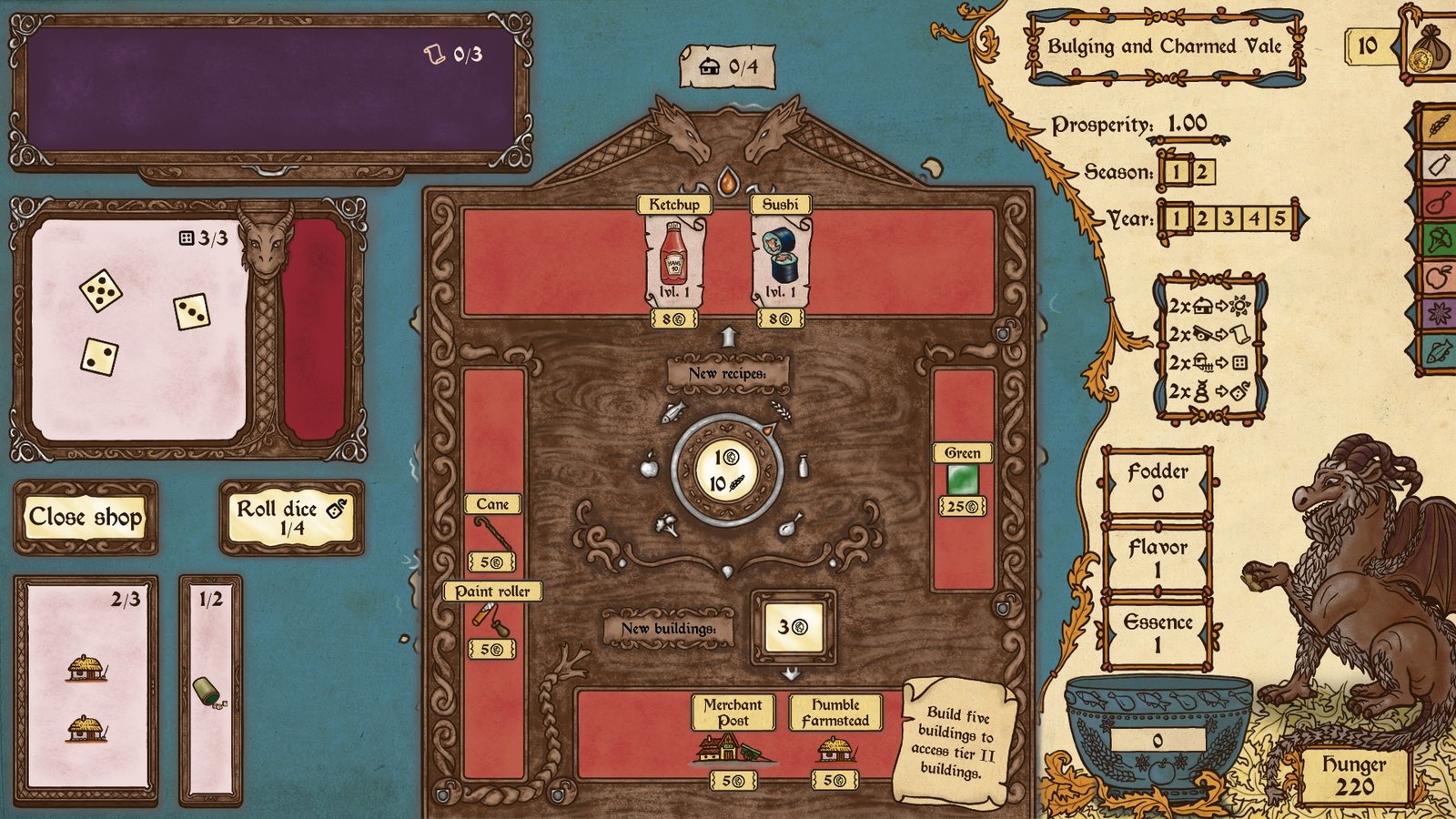
If you want more turns to roll the dice, you can invest in some shrines. If you want more recipe slots, you can invest in some trade posts. This keeps making certain aspects of the game easier and gives you the ability to handle the late-game insane food demands. However, despite all of this, there are some tricks that you can use by combining the right recipes and bonuses from buildings. You can also purchase tools, which are one-time-use items, and provide active or passive bonuses like leveling up a recipe or allowing you to use a recipe twice during the same cook.
Feed the Scorchpot also features an in-game shop where you can buy new buildings, items, recipes, and dice types by spending the ducats that you earn at the end of every year. If you manage to meet the hunger target with seasons still left for the year, you will gain prosperity. All of this may sound very complicated to you because it is, but the game’s design and intuitive UI make it very easy to manage everything. After spending just 10 minutes in the tutorial, I was able to understand everything quite easily. The tutorial does an excellent job of explaining game mechanics. Everything falls into place perfectly. The game does not have a proper story, since every run is played in a roguelike format. Even the island is randomly generated every time.
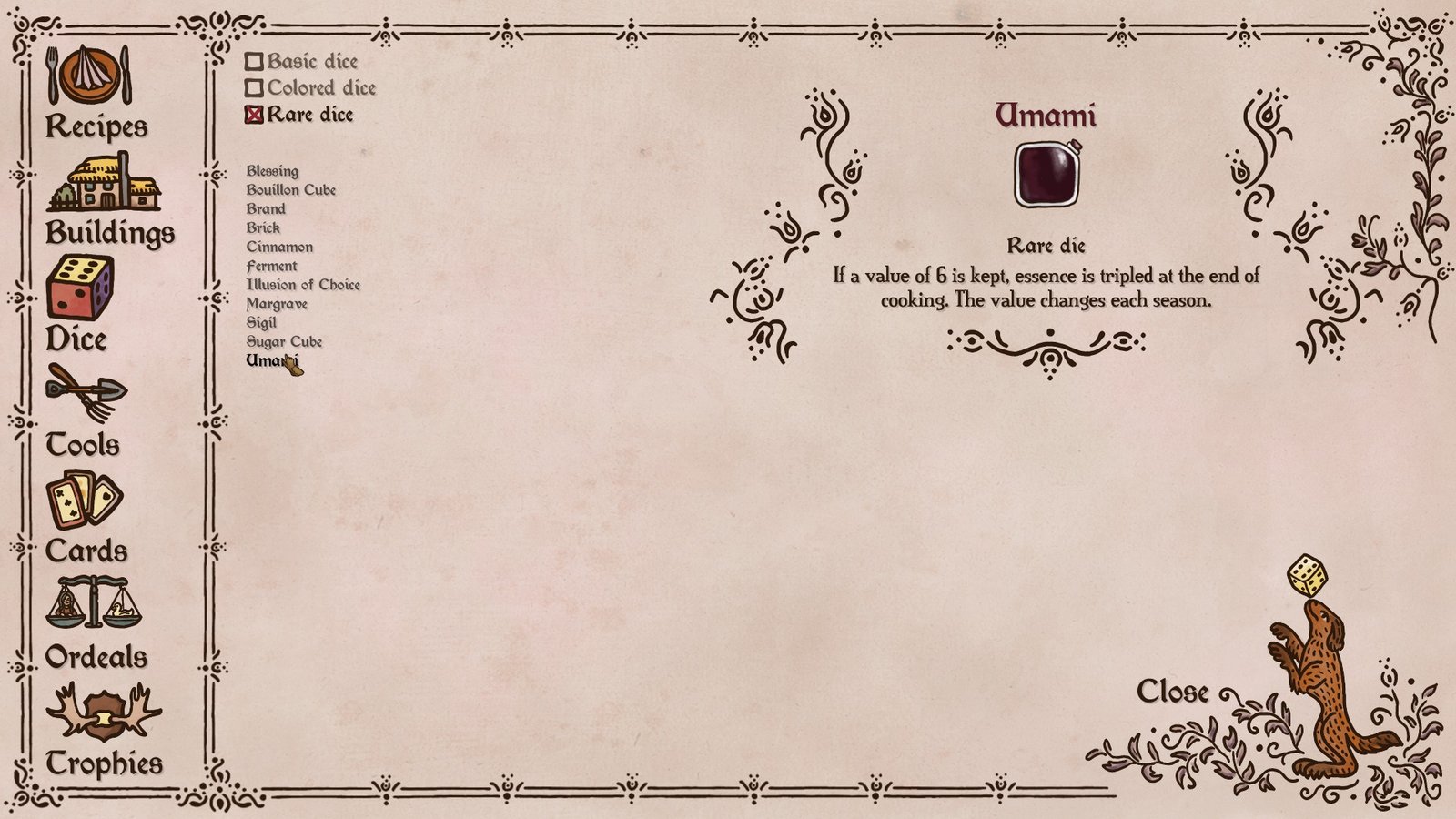
Feed the Scorchpot offers eight unique dragons to choose from. Each dragon comes with its unique traits. For example, if you want the base experience, you can choose Baron. Other dragons offer some bonuses but will also demand something in return. Such as, if you go with Count, it is extra hungry, but it creates a feeding ground, which results in increased yields for ingredients. Similarly, if you choose Empress, you will need to feed it more, but you will get three additional deckbuilding points. You can also pick the game mode at the start from different options. Each option has its own unique modifiers, which will increase or decrease the challenge. Similarly, different types of dice can be purchased from the shop, which also come with their own unique bonuses.
My favourite aspect of Feed the Scorchpot is easily its visuals. Despite them being very simple, I love the hand-drawn art style of the game. The dragons, the overall UI of the game, and the unique hex-grid island settlement view with its colored tiles and small buildings placed on the hexagon ends really represent a vibe that is hard to pull. There are a lot of intricate details all over the screen that clearly show the love and attention to detail the developers have put into the game. There are little animations here and there, like the small tools being used, placing down buildings, the dice rolling with a minor thud on the tray; everything is just excellent to look at. As the level progresses, the island gets filled with multiple buildings like small houses, shrines, trade posts, docks, and some upgraded buildings. Everything is designed very well and with care.
Technically, Feed the Scorchpot is a well-optimized game. While it is true that the game is not that demanding on the hardware, it does combine a lot of mechanics into a single run, and everything works perfectly. During the entire playthrough for this review, I managed to unlock nearly all dragons in the game, and the game did not crash once or give me any sort of gameplay bugs. I played with a keyboard and mouse, and the controls felt right. Nothing came to mind that would require fixing or further optimization. The developers have done an excellent job at making it bug-free and performing optimally.
Related News:
- Review: Rustic Defense – A Strategic Tower Defense Roguelike That Rewards Patience
- PvPvE Roguelike Platformer Reloadian Gears Up for Upcoming Steam Next Fest
- Brutal Roguelike Tactical RPG Lost In The Open Launches on PC Steam in Early Access
Final Verdict:
Feed the Scorchpot is an insanely fun game with an addictive gameplay loop that keeps you entertained right until the end. While the gameplay is incredibly satisfying, it is equally challenging, as one wrong dice selection can lead to a shorter yield and potentially result in an untimely death. The beautiful hand-drawn visuals, combined with satisfying deck-building mechanics, deliver a polished and engaging roguelike experience. At no point does it feel like a game developed by just two people. If you enjoy roguelike games with unique themes, excellent gameplay, and plenty of challenge, Feed the Scorchpot is an easy recommendation.
Final Score: 9.0/10
Disclaimer: A PC Steam review code for Feed the Scorchpot was provided by Two Frogs in a Trenchcoat on behalf of Indieformer. For a detailed breakdown of our scoring and review process, please refer to our Review Policy.