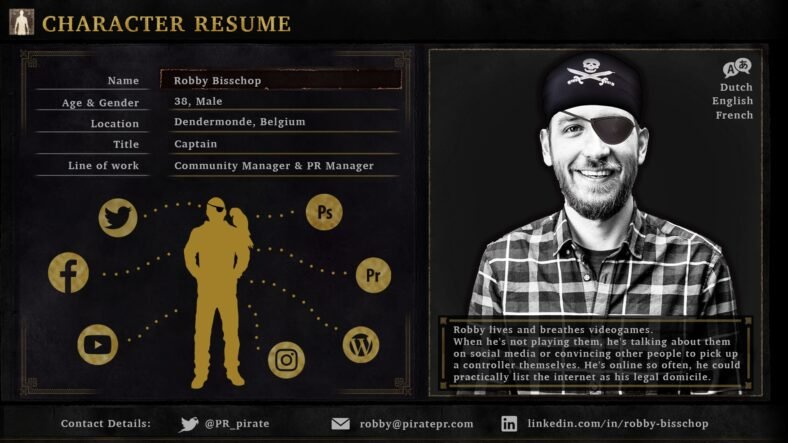
Video game PR is the backbone of every video game launch since this industry kicked off, and the first developer decided to market their game before its release. Whether you see a video game poster on the side of a bus in downtown New York or a magazine in Australia, there is a PR agent behind it who is working hard to ensure that it reaches the right ears and eyes. There are many cases where an excellent game is unable to sell because of its bad PR campaign, so in short, the PR people working on spreading the word about a video game are the unsung heroes of this industry who never come to the spotlight themselves, but they bring the games into the spotlight. Today, we are speaking with Robby Bisschop, an award-winning PR specialist who has launched some of the best titles that we have played in recent years, including Trifox, SCHiM, and Ruffy and the Riverside. This is our interview with Robby Bisschop of Pirate PR, in which we explore the world of PR and see how Robby’s experience has been in this quiet side of the industry.
GH: Let’s start with the basics. Please tell our audience a little bit about yourself. Who exactly is Robby Bisschop?
RB: I’m 38, live in Belgium, and I’m married and have two kids. I’ve been a gamer all my life, or at least from the moment my parents allowed me to have a Game Boy (and it took 6 more years to get my first console). I love bad puns, nostalgia, and escaping into new worlds when work gets too much.
GH: Can you tell us about your journey into video game PR and what initially attracted you to this side of the industry?
RB: I studied videogame design from 2005-2008, but the education was disappointing at the time, (I) never did much with it (other than working on Ketnet Kick 2, which was a game made by Larian). I then spent 10 years doing SharePoint Support at the European Commission and wrote reviews or did developer interviews as an unpaid hobby in my off-hours. Eventually, that allowed me to start as the Community Manager for a Belgian publisher and gaming expo (1UP Conference). After COVID, I started Pirate PR to focus even more on what I did best.
GH: How would you define yourself as a gamer?
RB: I love RPGs (escapism) and rhythm games, even though I suck at the latter. I play to relax or give my head a break from everyday concerns. I’ll always play my games on easy and rarely look for a challenge.
GH: Looking back, was there a particular project or moment that defined your career direction in games PR?
RB: Even though it wasn’t a commercial success, and I didn’t know half of what I do now, I’d have to say Trifox. They had a US publisher take over from the Belgian one right before the launch, but the devs kept me on to help with Press & creator outreach. And in the months that followed, it felt like all the coverage I saw was a direct result of my efforts. I’m still proud to have worked on that game, but feel like I could have elevated it even more with what I know now and the size of my press list that quadrupled in size.
GH: Did you work in any other PR agency prior to starting Pirate PR?
RB: No, though I did help with the PR for Journey for Elysium and Trifox, when that was handled by the publisher I was working for back then (Cronos Interactive). My main responsibility was handling social media & community. But I have been on the receiving end of hundreds of press releases before I started Pirate PR, and often thought, “I can do this better”.
GH: Do you think that relevant education helps in video game PR?
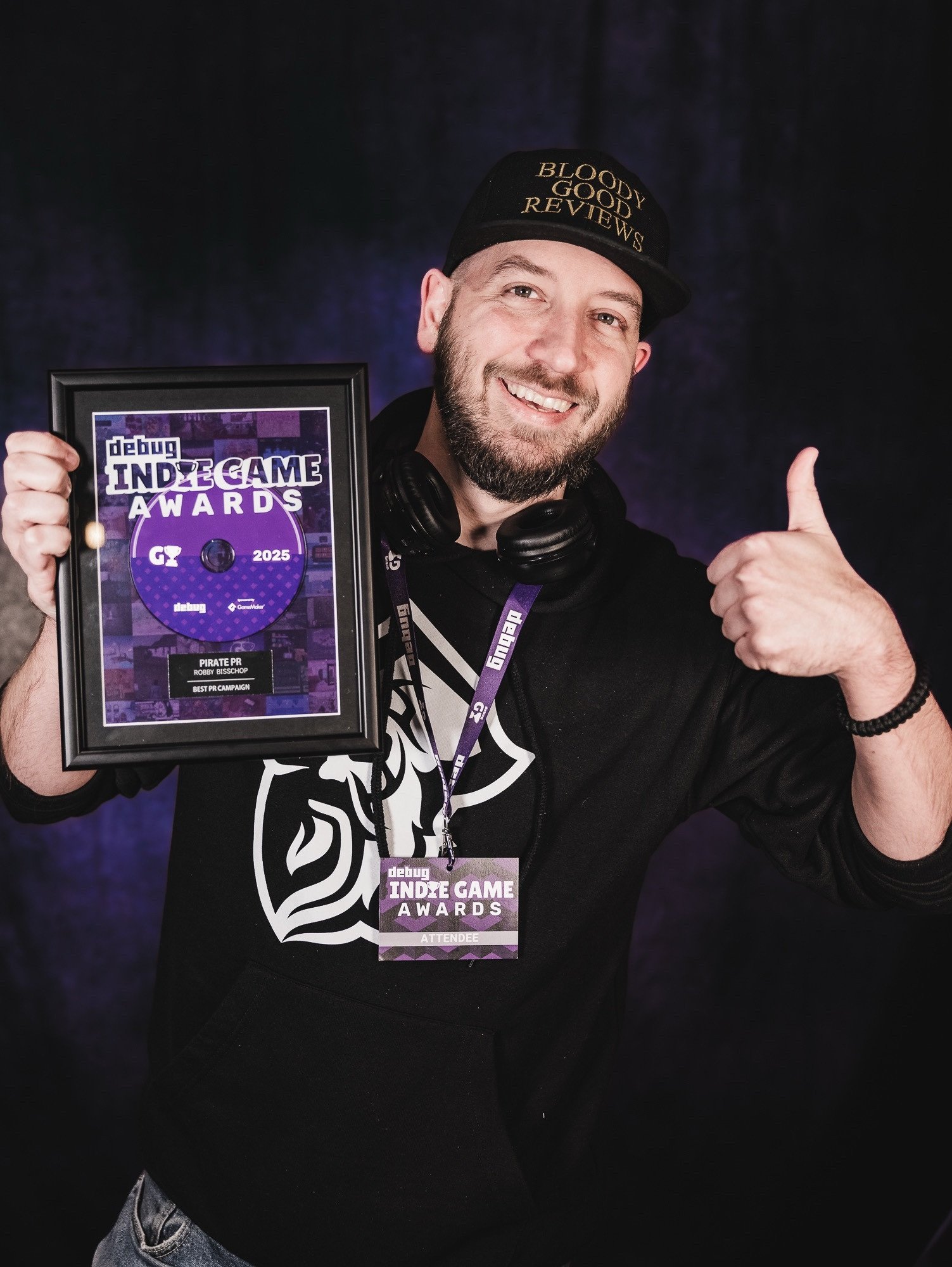
RB: It depends. Writing certainly helps. And in my case, even knowing how a game is built helps me talk the same language as the developers (to a certain degree, I sucked as a programmer). I’m happy with the road I followed, even though it never looked like I’d end up where I am now.
GH: What are your current responsibilities at the helm of Pirate PR?
RB: Everything, haha. Pirate PR is a ship with a crew of one, though I do sometimes outsource certain tasks to others when it looks like I’ll be overwhelmed. I also have a flexible solution where I coach devs to handle things themselves, and since they execute some stuff in that scenario, it saves them money and me time. But for a lot of games, I handle 100% of the PR-related tasks, from prep work to Press Releases and code send-out.
GH: You’ve worked across multiple campaigns and titles. Which project best represents your approach to PR, and why does it stand out for you?
RB: I’ve got a few that come to mind: SCHiM, Ruffy and the Riverside, OFF… It’s not like I’ve reinvented the wheel for them. They were all games with some existing fanbase already. But the devs were good at talking to their audience via social media, and that allowed me to focus 100% on PR. All of these had thousands of code requests and dozens of day-one reviews.
But if we’re going for original ideas, I’ve also have a few that come to mind. Like sending out a press release in a spreadsheet format, for the game Spreadcheat.
Or working a puzzle box into the key request form for Parallel Experiment, where solving the optional HTML5 puzzle box after filling in the form gave access to a code that would reveal a secret in the game.
Or even helping the devs of Necro Story rewrite their trailer and coming up with a rhyme to make the trailer more intriguing to watch.
It’s fun to do things well by the book, but when a chance to be creative presents itself, I get all giddy!
GH: How do you personally define success in a video game PR campaign, beyond sales figures or launch-day metrics?
RB: Basically, by how many people recognize the game. They’ve seen it in articles, a trailer in a showcase, social media posts, their favourite creator playing the demo or the full game. If I did my job right, they’ve seen the game at least 7 or 8 times before they spot it in a store and decide to buy it.
GH: The games industry is more crowded than ever. What do you believe separates an effective PR strategy from one that gets lost in the noise?
RB: Effectiveness & appeal. First, you draw them in with a witty pun, interesting title, or killer trailer, and then it’s just a matter of getting the correct info in the hands of the right people when they need it. It’s also when the devs feel like they have one less burden to carry. Being able to rely on their PR partner to handle that side of things and being their go-to person when they have concerns about their game’s visibility.
GH: Do you think cold email pitches work? How do you go about accepting campaigns at Pirate PR? Do you prefer reaching out to developers/publishers yourself, or would you rather if they reach out to you?
RB: I started (with) pitching (to) a lot of devs myself and always ran into the same wall of not having a portfolio of titles I worked on yet. That first year after starting Pirate PR at Gamescom was painful because I felt like I still had to prove myself. But these days, 9 out of 10 of my clients are the ones who reached out to me. Most often because of word-of-mouth and satisfied clients spreading the word, and sometimes also because I offer free advice and insights via my website, and they end up working with me after I give them free feedback or a call to assist them with a question they had.
GH: How has the growing influence of streamers, content creators, and community-driven platforms changed the way you approach PR today?
RB: It’s constantly shifting. When I started, Press had a way bigger impact than they do now. And Twitch streamers were the main content creators to reach out to. Now it’s either short-form content on TikTok, well-edited YouTube videos, and written press is in a steady reader-decline. My Press list has evolved alongside that, and I currently have a 40/60 split between press and creators. Just 4 years ago, it was 70/30.
GH: When working on a new IP versus an established franchise, how does your messaging and outreach strategy shift?
RB: I’ve not had the opportunity often to work on a well-known IP. OFF comes to mind, but that was mostly known by a niche fanbase. And Coffee Talk Tokyo is a sequel to a well-known franchise.
It shifts a bit in that I respect the fanbase and what they already know. In the case of OFF, when I was sending out press releases to people, of which I didn’t know how familiar they were with the game, I had to use hooks like “this game inspired UNDERTALE and DELTARUNE” and “with music from Toby Fox”. But when I was speaking to an existing fan, I knew I had to avoid that because they get pissed that those other titles have to be used to hype their favourite game, and they know it was the OG.
GH: Game launches don’t always go as planned. How do you navigate PR during difficult moments such as delays, criticism, or mixed reception?
RB: I don’t think I worked on a single game last year that was released when it was originally planned to be released, at least not as far as review keys/codes were concerned. It’s mostly difficult because I have to promise my clients I have time for them, but when one game delays and another has a surprise jump in when it releases, it can create a perfect storm of needing my attention at the same time. I haven’t quite solved how to work around that, and it usually just means 60-hour workweeks with evening and weekend work…
As for criticism & mixed reception: that’s tough. In an ideal world, there is room to improve the game and try again. If that is not an option, it’s key to focus on the positive voices in the room and not let the negative ones eat away at your motivation. Luckily, most of the games I worked on have been received well, and I normally only say yes to games I’m into as a gamer myself.
GH: What is the biggest misconception people have about working in video game PR?
RB: “oh so you get to play a lot of games?”
This goes for pretty much any job in games media, but usually you still end up actually gaming in your “off” time, outside of business hours. And instead of getting to play more, as some would expect, you’re now playing clients’ games in your free time, as that is the only moment available to learn more about it. After all, no one is going to pay you to play the games, only to market them.
GH: Can you share a challenging experience from your career that ultimately helped shape you professionally?
RB: I started Pirate PR with someone I knew would be a good fit to help build the brand, but it was clear from the first few months that this was not a business that could support 2 full-time employees unless both of them were getting the same output.
Downsizing to just me made it so I was suddenly responsible for client outreach, quotes and contracts, financial reporting, setting up tools, etc., all things I could rely on my partner before. But taking that step to sail solo was the most important turning point, and I thought I didn’t have what it takes, but now I’m thriving. Even with the newfound success, I’m very hesitant to grow the company because of that. I think I work better on smaller projects and when I don’t have to rely on someone else.
It feels like the world wants me to grow the company to a bigger size, and there is potential for that, but I’m not cut out to be a leader/boss.
GH: If there is one video game that you would love to have in your portfolio, which one would it be? This could be from the past or the future.
RB: I love this question! Dead as Disco. It’s an upcoming rhythm game, and I was completely hooked on the demo at the end of last year. I’ve had a brief chat with the founder of the studio, and I’d love to work on it, but I think it may be out of (my) scope with how popular this could end up being.
GH: Where do you see video game PR heading in the next few years, particularly as audiences become more vocal and involved?
RB: I don’t know, but part of me is afraid that the market will grow more and more towards paid video content. Where even small to medium creators are asking (for) money for content and have agents to negotiate for them. If that is a trend that continues, I fear for the job of organic Indie Game PR.
GH: How important is transparency and honest communication in building long-term trust with gaming communities?
RB: I’ve shared most of what I know in some form already on social media or in my articles on my piratepr.com website. And I’ve been very open about things like key scammers and the difficulties of doing indie game PR, and I feel that level of honesty and openness has really positioned me in such a way that Indie devs quickly know I really care about their games and that I put that before anything else.
GH: What advice would you give to someone looking to break into video game PR today?
RB: Start by being your audience. Report on games first. Write for a website or create content of your own, so you know what they need.
GH: If you could improve one aspect of how PR is handled within the games industry, what would it be?
RB: More openness about prices. Some bigger PR agencies ask waaaaaay too much, even from smaller devs. And if developers have calls with one or two such companies and hear their crazy pricing, they may decide that it’s something they can’t afford. But there are smaller companies and freelance PR agencies that can help at an affordable rate. I would recommend all of them to be open about their packages and what people get at what cost. My price list is public in the pitch deck on my website, and I’ve had a ton of clients who previously thought what I offered them would be out of their budget.
GH: After spending 8 years in this industry, if you could go back in time, would you pick a different industry or a different field in the video game industry?
RB: Shortest answer on the interview: hell no!
GH: Finally, what upcoming projects or initiatives are you most excited about right now?
RB: There are so many I can’t say anything about yet, haha. But I’ll briefly give a glimpse into the few where I can:
STIP is a numbers puzzle game with a dark meta-narrative that’ll let us do cool things. We’ll hide codes in trailers, press releases, images, socials, and websites, each unlocking hidden secrets in the game. If you search for the announcement trailer, there is a code there already I’d write down. 😊
Helix: Descent N Ascent and Lelu are two monochromatic games that share almost nothing else but their colour-devoid styles, but both look and sound amazing, and I’m excited to play more.
And if you like Poker, we’ve got The Devil’s Due coming that has a demo I’ve been hooked on for 8 hours already. For a demo! You’ll have to cheat your way out of hell in that one.
And there’s cozy games like Collectors Cove, Coffee Talk Tokyo, and Golden Retriever simple life! And visually stunning games like Voidling Bound and … oops, almost spilled the beans!
Anyway, too many to mention, but I’m excited for all of them. Have a watch at our hype reel for what’s in store:
At the end of this interview, I would like to thank Robby Bisschop for taking time out of his PR duties and answering our questions with so much detail. Video game PR is definitely a hard task, and running a PR agency solo is even harder. Make sure to check out Pirate PR’s official website and reach out to Robby if you need help with PR for your next game.